Jill for City Council
Boulder for All
Who is Boulder for?
Most people who have lived in Boulder for a while can feel that something has shifted.
Beloved restaurants and watering holes are closing. Downtown offices and storefronts sit empty. Neighborhoods are darker at night, and there are fewer children in our schools. For many, Boulder feels more hollowed out and less community-centered than it once was.
This is more than a feeling. The indicators that show whether a city is thriving, including population + job growth, school enrollment, and sales tax revenue, have flatlined. Despite thousands of new housing units and a growing university, Boulder has struggled to translate its extraordinary prosperity into a stronger, more rooted & resilient community.
This trajectory is not inevitable. It is the accumulated result of choices, and we can choose differently.
We can bring empty homes, offices, and storefronts back into use. We can build housing for the people who work here. We can restore the third places where community happens, refill our schools, and keep more of the wealth generated in Boulder circulating within Boulder.
This will require practical reforms to development, permitting, and ownership, along with fiscal responsibility and the political courage to put community vitality ahead of the passive accumulation of property value.
I am running for City Council because Boulder should be more than a valuable place to own property. It should be a place where people can belong, raise families, build businesses, and grow old.
- Jill Adler Grano
About Me
Boulder has given me more than I could ever have imagined. It is where I raised my two sons, built a career, found friends and mentors, and met the love of my life. It also trusted me with public office and gave me the opportunity to serve this community through moments of crisis and change.
For more than two decades, I have worked in housing, advocacy, business, and public service. I have worked alongside residents of manufactured-home communities, volunteered with Meals on Wheels and the Boulder Shelter for the Homeless, and served with organizations including Boulder Housing Partners, Thistle, New Era Colorado, and the CU Center for Leadership.
In 2017, Boulder voters elected me to City Council, making me the first openly gay woman in the city’s history to serve. On Council, I fought for attainable housing and small businesses, helped expand access to accessory dwelling units, and advanced stronger gun-safety laws.
I later spent three years leading community affairs in Congressman Joe Neguse’s district office, helping residents navigate government during the federal shutdown, the pandemic, and the aftermath of the King Soopers shooting.
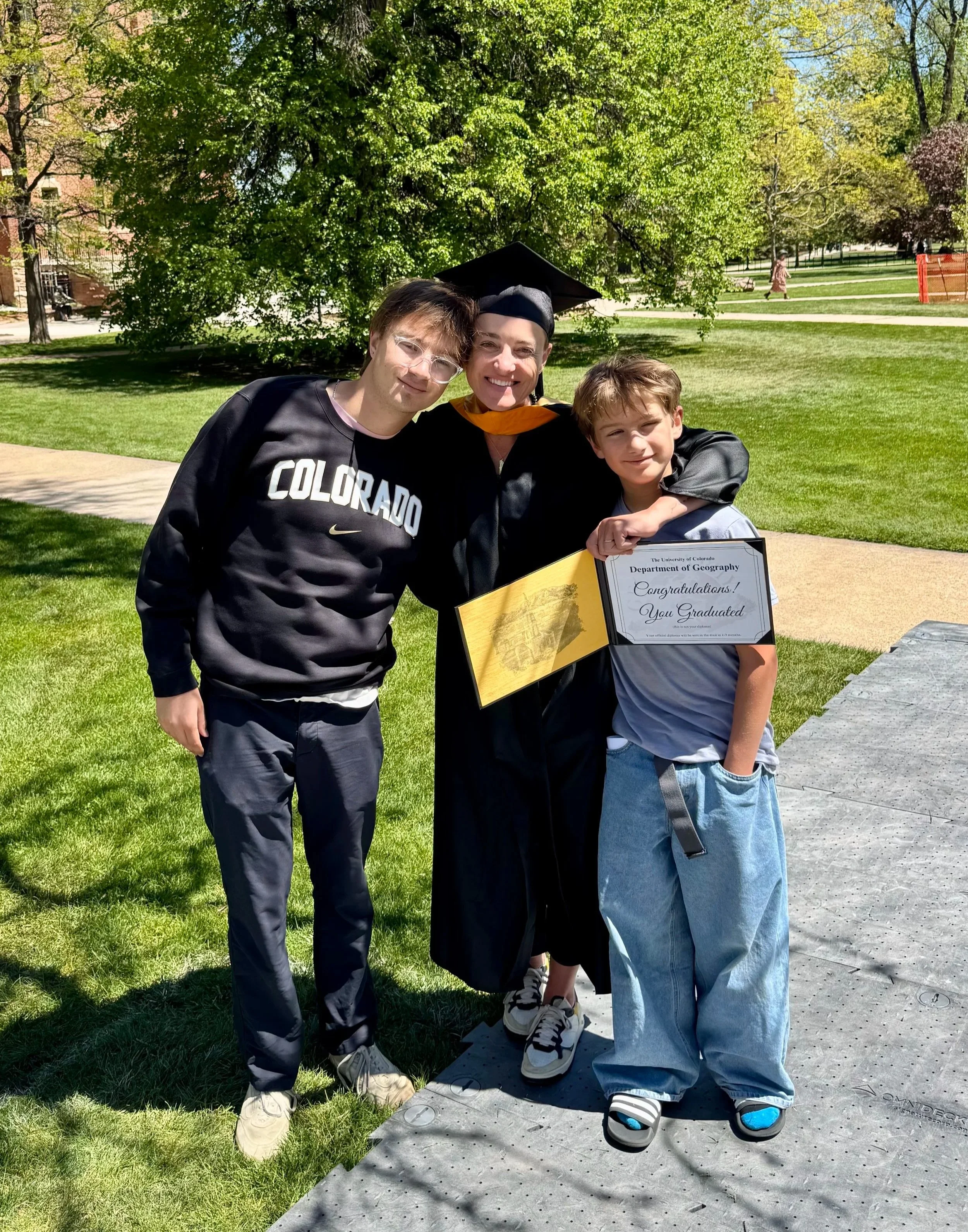
I hold a degree in Government from the College of William & Mary and a master’s in Geography from the University of Colorado Boulder. My graduate research traced 150 years of Boulder housing policy. It reinforced something I have learned throughout my career: Boulder’s challenges did not just happen to us. They were shaped by decisions.
That means different decisions can shape a different future.
I am running for City Council because I know Boulder deeply, I understand how we arrived here, and I want to help keep it a place where many more people can build extraordinary lives of their own.
What’s happening to Boulder
Boulder’s biggest challenges may look separate, but they are connected. Empty homes and storefronts, declining enrollment and revenue, and a growing maintenance backlog all point to the same problem: too much of the value created here is no longer rooted here.
-
Downtown office vacancy sits at 29%, four times pre-pandemic levels, and higher still when you count subleases. Pearl Street is some of the most valuable land in Colorado. The city maintains the streets, sidewalks, lighting, and utilities around it at full cost, and roughly a third of the storefronts and offices on that land produce little to no revenue: no sales tax, no jobs, no foot traffic. I can't think of another land-use category in Boulder where the gap between what we spend to serve the land and what we get back is anywhere near this wide.
Meanwhile, the people who want to fill those spaces can't get in. In the last month, I've talked with a woman planning a coffee shop that becomes a music venue and wine bar at night, and another building a wellness collective where each practitioner has their own corner. Both are exactly what you'd want in a vacant Boulder storefront. Both run headfirst into a code that treats a hybrid space as five separate uses, each with its own review path, and a temporary-use permit that caps pop-ups at two weeks while anything longer faces 200+ days of review. Our regulatory friction falls hardest on exactly the small, local, incremental operators we most need. Other cities have fixed this. Boulder can too.
-
Boulder is currently producing four kinds of new housing:
High-density apartment buildings, mostly purpose-built for students and mostly owned by institutional investors, renting at $1,500–$1,900 per bedroom.
Luxury townhomes are often acquired as second homes. (In 2024, I examined hundreds of public records of luxury townhomes in downtown Boulder and found that 34% were second homes.)
Multimillion-dollar scrape-and-builds, in which a modest existing home is torn down or doubled in size. Here are 108 homes that have sold or are for sale between $2,000,000 and $16,500,000, built since 2020.
Boulder Housing Partners’ permanently affordable inventory, which by every measure is the strongest housing program in the city.
We need more of the fourth, especially at 40% and below AMI. I struggle to see why we need more of the first three.
The number of homes matters. But it isn’t the only thing that matters. We also have to ask what we’re building, who can afford it, who owns it, and whether someone is actually going to live there.
-
Boulder is facing a budget shortfall, and it didn't come from nowhere.
The city owns 75 buildings totaling 1.8 million square feet. Fifteen of them are in critical condition. Fixing and replacing what needs it will cost roughly $500 million, and we've funded about 20% of that. Which leaves $400 million. We're about to ask residents to vote on a bond measure to cover it, which is debt we'd be servicing for years (we need the measure to pass to fund the South Boulder Rec Center and other projects, but it is still a lift for the community). All the while, we keep adding: new assets, new programs, new obligations, each one carrying a maintenance burden that lasts decades.
At some point we have to start asking basic stewardship questions. What does each acre of this city return, relative to what it costs to serve? Which buildings should we keep, and which should be sold or repurposed for housing, for small businesses? Did past investments actually deliver what was promised?
Boulder voters have been generous. Tax after tax, passed in good faith. That generosity should be earned, not assumed. The way I look at it is that every underperforming acre, every dark storefront, every empty home is revenue we're leaving on the table while services get cut. Before the city asks residents for more, it needs to show it's a careful steward of what it already collects.
-
Boulder once produced its own wealth. Companies started here, made things here, hired across the income distribution, and reinvested locally. That still exists in pockets, but the trend line points the other way. Blackstone now owns more than $800 million in Boulder real estate. Institutional landlords control thousands of multifamily units and a growing number of commercial buildings. A UK defense conglomerate owns what used to be Ball Aerospace. A private equity firm owns Horizon Organic. The list goes on.
Each acquisition has its own story, and each can be read as a measure of success. But the cumulative pattern is that value is generated here and captured elsewhere. The rent we pay flows through institutional owners to shareholders and sovereign wealth funds on other continents. Even our public dollars leave as the city, county, CU, BVSD, and Boulder Community Health spend hundreds of millions a year on goods and services, most of it with vendors headquartered elsewhere, banked elsewhere, taxed elsewhere. A dollar spent with a local business circulates two to four times before it leaves town. A dollar spent out of state leaves immediately.
-
A commercial vacancy tax was proposed and then withdrawn. But that does not mean Boulder is out of options. There are other tools we could use.
Make temporary uses and pop-ups easier. Boulder generally regulates temporary businesses as if they were permanent. The current permit allows temporary sales or outdoor entertainment for only two consecutive weeks in a three-month period. Anything longer can trigger a full Use Review, which may take more than 200 days.
In practice, a six-month pop-up coffee shop in an empty office can face nearly the same regulatory process as a permanent development. So almost no one tries.
Other cities have tried to solve for this. Washington, DC allows streamlined pop-up occupancy for up to a year. San Francisco’s Vacant to Vibrant program connects small businesses with property owners to create temporary shops and community spaces. Austin has allowed temporary retail permits since 2011.
Create a category for hybrid and creative businesses. Many of the businesses people want to open today do not fit neatly into the categories in Boulder’s code.
We want diverse and eclectic businesses, but Boulder’s Use Table often does not know how to treat multiple uses in one business concept.
Other cities are simplifying their use categories. New York recently combined café, bar, and live-music uses, while Buffalo moved away from traditional use-based zoning altogether. Boulder is already updating its Use Table, which gives us a chance to address this.
Create an adaptive-reuse path for long-vacant buildings. A local business or small developer willing to bring an older, empty commercial building back to life should not face the same timeline as a large, ground-up development.
Los Angeles has used adaptive-reuse rules to convert vacant downtown buildings into thousands of homes and has now expanded the program citywide. Boulder could create its own version for older commercial spaces along Pearl Street and East Pearl, as well as in our eastern industrial areas.
This would not change the underlying zoning. It would simply recognize that regulatory delay is especially costly for small, local operators (often the very people we most want to attract).
Help legacy businesses secure long-term leases. San Francisco’s Legacy Business Program supports businesses that have operated for at least 30 years and contribute to the character of their neighborhoods. Landlords who offer qualifying businesses 10-year leases can receive grants, with part of the benefit required to go directly to the tenant.
Boulder has many longtime businesses that could qualify for a similar program. It could help keep the places people love from being priced out while giving property owners more stability.
Filling vacant commercial spaces with local businesses is one of the highest-return-per-acre moves Boulder could make. It brings life back to our streets, supports local entrepreneurs, and helps close the city’s budget gap. And the benefits compound, because every occupied storefront puts more money back into the local economy.
-
We need more housing. But we also need to pay attention to what kind of housing we create and whether it becomes a home for someone who lives here or another asset for an investment fund or second-home buyer.
Unless Boulder chooses to open new land for family housing, one of our best options is incremental, owner-driven housing: one or two homes at a time, built by homeowners on lots already served by streets, water, sewers, and schools. When done well, this can also prevent existing homes from being scraped and replaced with something much larger and more expensive.
Picture a retired couple building an ADU, moving into it, and selling their ranch house to a young family. Or a homeowner adds a small unit for an aging parent. Alternatively, a 1950s ranch on a deep lot becomes two attached, separately owned homes.
This is not a radical new housing form. It is how many of Boulder’s older and most beloved neighborhoods, like Whittier, were built. But today, our code makes this kind of modest, incremental housing surprisingly difficult.
Four reforms could make a meaningful difference.
Offer pre-approved ADU plans. Boulder has already loosened many of its zoning restrictions on accessory dwelling units, and the State of Colorado has pushed in the same direction. At this point, zoning is not always the biggest obstacle. Design, engineering, and permitting costs are.
California now requires cities to make pre-approved ADU plans available to the public. Homeowners can choose from a catalog of architect-designed, code-compliant options rather than starting from scratch. That can save months of work and tens of thousands of dollars.
Boulder could do the same. Not every homeowner would use a standard plan, but many would.
Let homeowners sell an ADU separately. Today, a Boulder homeowner can build a backyard cottage, basement apartment, or converted garage, but the new unit must remain tied to the main house under the same ownership.
The next step is to let homeowners sell the ADU separately through condominium ownership. This would not require dividing the land or creating a new lot. The two homes would simply have separate deeds, much like the units in a small duplex.
One house could become two owner-occupied homes, at the property owner’s choice, on a lot the city already serves. Colorado’s Department of Local Affairs already recommends separate ADU sales as one option for communities trying to expand homeownership.
Protect these homes from immediate investor capture. Allowing separately owned ADUs and small-scale infill without any guardrails could simply create another pool of LLC-owned rentals. We should be careful about that.
Vail offers one possible model. Through its Vail InDEED program, the town pays property owners to accept a permanent deed restriction requiring the home to be occupied by someone working locally. The restriction applies to who lives there, not who owns it, which gives property owners flexibility while keeping the home connected to the local workforce.
A Boulder version could be attached to newly created ADUs or other incremental homes. The goal would be simple: make sure the housing we enable actually houses people who live and work here.
Expand intergenerational home-sharing. Boulder is already working on this and should keep going.
Many older residents live alone in homes that are larger than they need. At the same time, graduate students, younger workers, teachers, and lower-income residents struggle to find a room they can afford.
Home-sharing programs match people who have extra space with people looking for housing, with screening and support built into the process. Washtenaw County, Michigan, recently launched a program primarily aimed at older homeowners and local housing seekers.
These programs are relatively inexpensive, and they create usable housing without building anything new. They can also address a problem that zoning reform cannot: the isolation many people experience as they age alone in a house once meant for a family.
The larger point is that these ideas are not only about adding housing units. They are also about who benefits from growth.
Incremental housing spreads opportunity among many individual homeowners rather than concentrating it in a few large development companies.
-
Take care of what we already have first. Boulder’s first discretionary dollar should go toward maintaining the buildings, streets, and corridors we already own before we add new facilities or expand at the edges.
Every new asset creates a maintenance obligation that lasts for decades. Boulder’s Facilities Master Plan covers 75 buildings totaling 1.8 million square feet, with a replacement value of more than $550 million. One of its two guiding priorities is consolidating city uses.
Buildings the city no longer needs should be leased, sold, or repurposed for housing, small-business space, or other community uses. The proceeds could help maintain the facilities we keep or pay down debt on underfunded buildings.
Area III is the one place where this principle may get more complicated, but only if Council decides to make middle-income family housing there a real priority. Producing the kinds of homes and prices those families need would require a serious public commitment. More on that below.
Measure the return we get from limited land. Boulder already evaluates major projects using many criteria. We should add a simple one: how much economic and tax activity does a property generate per acre, compared with what it costs the city to serve?
Our land is limited, and demand is high. That makes modest infill in places already served by streets, utilities, and transit especially valuable. When an acre consistently produces less revenue than it costs to support, the rest of the city is subsidizing it.
Urban3 has completed this kind of value-per-acre analysis for cities around the country, including Durango. Its maps show, parcel by parcel, where a city is generating revenue and where it is losing money. Boulder has not done that analysis, as far as I know. It could give residents and elected officials a much clearer picture of how our land-use choices affect the city’s finances.
Show stewardship before asking residents for more. This entire framework depends on public trust. And trust is not something the city can keep spending without earning it back.
Boulder voters have been extraordinarily generous, approving tax measure after tax measure in good faith. The city should regularly show residents what they received in return.
Boulder’s Charter allows for an independent city auditor. San Diego created such an office, which helped expose roughly $1 billion in deferred maintenance that might otherwise have remained hidden.
Accountability is not austerity. It is how we build the trust and financial capacity to do everything else.
-
We need to keep more public spending in Boulder. The City of Boulder, Boulder County, CU Boulder, Boulder Community Health, and BVSD collectively spend hundreds of millions of dollars each year on goods, services, and contracts. Much of that money goes to companies headquartered elsewhere, leaving our local economy immediately.
The idea behind local procurement is this: when possible, spend public and institutional dollars with local businesses. And when the business we need does not yet exist, help someone build it.
A dollar spent with a local supplier does not stop with that transaction. The business uses part of it for local wages, rent, and other suppliers, creating another round of spending. Economists call this the local multiplier. Research generally finds that money spent at independent local businesses circulates much longer than money spent at national companies or out-of-state vendors.
This is not a new idea. Cities and institutions around the world use procurement to strengthen their local economies, and Harmon Zuckerman, one of Boulder’s most thoughtful former Planning Board members, has advocated for it here for years.
Preston, England, offers one of the clearest examples. Beginning in 2013, the city worked with major local institutions, including its university, hospital, police, housing association, and local government, to track where their purchasing dollars went and redirect more of them to qualified local suppliers.
Over five years, the share of spending retained within Preston rose from 5% to 18%. The share retained in the surrounding county rose from 39% to 79%. About £200 million was redirected into the regional economy without raising taxes or increasing total spending.
Boulder could begin with three practical steps.
First, find out where the money goes. The city and other major institutions should commission a joint procurement analysis showing how much they spend locally, elsewhere in Colorado, and out of state. This kind of work can be done by an outside consultant and is often eligible for grant funding.
Second, set realistic local-supplier goals. Within the limits of Colorado procurement law, Boulder could establish targets for increasing the share of contracts awarded to qualified local businesses. Even redirecting a modest portion of current outside spending could generate tens of millions of dollars in additional local economic activity.
Third, help local businesses compete. Sometimes a local company could perform the work but does not know how to navigate a public bidding process. Other times, the contract is too large for one small business to take on.
The city can address that by breaking large contracts into smaller pieces where appropriate, helping businesses understand bidding requirements, and supporting partnerships among local firms. None of this is especially complicated.
The same basic question applies to the city’s own investments….
Boulder maintains an operating investment portfolio of roughly $454 million. Most of it is held in federal securities and bonds issued by large national and multinational corporations. That approach may be safe and conventional, but it produces virtually no direct economic benefit in Boulder.
State law appropriately limits how public money can be invested, so this is not an argument for turning city funds into venture capital. But there may still be room to do more locally within those guardrails.
That could include bonds issued by Boulder-area public entities, deposits at qualified local financial institutions tied to commitments for local small-business or affordable-housing lending, and a modest impact-investment allocation similar to the affordable-housing bond the city already owns.
This, too, should begin with a baseline. An independent municipal finance adviser could review the city’s portfolio, identify legally available local options, and clearly explain the tradeoffs involving return, risk, and liquidity.
The larger point is that Boulder already spends and invests enormous amounts of money. Before asking residents for more, we should make sure more of the money already moving through our public institutions is helping build local businesses, local jobs, and long-term community wealth.
The path forward
None of this is inevitable. Boulder can become a more rooted and generative city… one that helps local businesses grow, puts empty spaces back to work, creates homes people can live in, and keeps more of the wealth we create circulating here.
Other Key Issues
Safe public spaces + pathways out of homelessness
I do not think Boulder should have to choose between compassion for people in crisis and safe, usable public spaces.
People experiencing homelessness need a realistic (and holistic) path toward stability that includes shelter, housing, mental/behavioral-health care, substance-use treatment, and sustained case management. Moving people from one block or encampment to another is not a solution. Neither is allowing someone to remain outside indefinitely while their health and safety deteriorate.
Boulder’s parks, paths, libraries, and public spaces belong to everyone. Parents should feel comfortable bringing their children to a park. People should be able to walk or bike along a path without having to avoid unsafe areas. Businesses and neighborhoods should not be left to deal with problems that require a coordinated public response.
Local food + working lands
Boulder’s land-use rules often make it harder than it should be to grow, sell, and prepare food here. Farmers struggle to house workers on-site, use existing buildings, sell directly from their farms, and build the basic infrastructure their businesses need. Food-truck owners face a similarly complicated path through licensing, inspections, and restrictions on where they can operate.
We should allow safe farmworker housing, streamline direct farm sales, create a simpler path for food trucks, and help small producers share kitchens, storage, and processing space.
We should also make better use of agricultural open space. More public acreage could be stewarded by local growers, and existing farm buildings should be repaired and put back to work wherever possible. A year-round public market and stronger local purchasing by the city and major institutions would give farmers more dependable customers.
Climate resilience + risk protection
Boulder has a long history of environmental leadership, including protecting open space, implementing the Blue Line, securing clean water, and protecting wildlife habitats.
But climate action now has to be about resilience too. Wildfire, extreme heat, drought, flooding, poor air quality, and rising insurance costs are all real threats. The city needs to continue investing in wildfire mitigation, emergency planning, forest and grassland management, water security, and infrastructure capable of withstanding more extreme conditions.
We also need to keep reducing emissions from buildings and transportation. That means making it easier to improve and electrify existing buildings, creating safer alternatives to driving, and building homes closer to jobs and daily needs.
Protect manufactured homeowners
Manufactured homes are one of Boulder’s last paths to ownership for working families, older adults, and people with limited incomes. But residents are vulnerable to rising lot rents, neglected infrastructure & predatory financing.
The city should treat these communities as essential affordable housing by helping residents purchase their parks, preserving existing parks from redevelopment, and ensuring that water, sewer, roads, and other infrastructure are properly maintained.
We should also provide grants and affordable loans for home repairs, weatherization, and accessibility improvements, along with help resolving title problems and complicated financing agreements. In the city-owned parks, Boulder should model what secure manufactured-home ownership can look like: stable costs, well-maintained infrastructure, meaningful resident participation, and improvements made without displacement.
Safer streets + easier ways to get around
Too many of our most dangerous streets are also lined with apartments, schools, businesses, etc. The city has already identified many of the corridors where serious crashes happen, including 28th Street, 30th Street, and Broadway.
On 30th, we should move forward with the protected bike lanes and intersections that are already funded. On 28th, we should prioritize safer and more frequent places to cross. On Broadway, especially near the Hill and CU, we need better pedestrian safety and more reliable transit movement.
Roughly 65,000 people commute into Boulder to work each day, many of whom cannot afford to live near their jobs. Building more attainable housing near employment, allowing neighborhood-serving businesses, and improving regional transit can reduce traffic and boost economic vitality
Arts, culture + places to create
Boulder’s character comes from its artists, musicians, filmmakers, and independent venues. But space is stubbornly expensive, and the studios, workshops, and small venues where arts & culture happen are disappearing.
We should put empty storefronts and underused public buildings to work, and preserve industrial areas for artists.
Sundance will bring energy and opportunity to Boulder, but we should not become a city that embraces art for ten days and then makes it impossible for artists to stay here the rest of the year. We need to prioritize artists year-round.
Boulder voters have already chosen to invest in arts and culture. Now we need to make sure that money supports local artists, small organizations, affordable creative space, and year-round programming, not just major institutions and marquee events.